
 Buy Now, Pay Later

Shure BLX vs GLX-D+ vs SLX-D+: Which Wireless Mic Fits You?
Pick BLX if this is your first wireless mic or you want two handhelds that run on AA batteries. Pick GLX-D+ if you are done buying AAs and want a license-free digital mic that charges in its receiver. Pick SLX-D+ if you work venues, churches or corporate gigs every week and want pro digital wireless with the longest listed range of the three.
Three Shure families, three jobs
Shure makes all three of these lines, and all three come as a handheld mic plus a receiver that plugs into your mixer or powered speaker. The gap between them is in how the signal travels, how the mic is powered and how much control you get.
BLX is analog UHF and runs on AA batteries. GLX-D+ is digital, works in the 2.4 and 5.8 GHz bands and uses a rechargeable battery. SLX-D+ is Shure's professional digital UHF line, with encryption and software control. Each one comes in a single version, and BLX and SLX-D+ also come as dual systems with two mics on one receiver.
Side by side
Here is what each listing on our floor says. Where a listing does not give a spec, we put a dash instead of guessing.
The SLX-D+ listings say they are shown in band G57, so ask us which band the unit on the floor is before you buy. Range numbers are line of sight, so walls, crowds and other wireless gear will cut into them.
Shure wireless mic systems compared (from our product listings). "Not in our listing" means our product page doesn't state it; ask us.
| Model | Mics | Band / signal | Range | Power | Capsule |
|---|---|---|---|---|---|
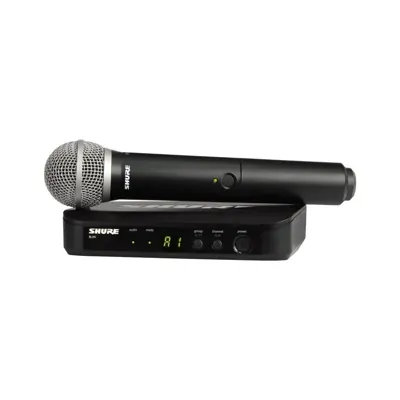
| Shure BLX24/PG58 Wireless Handheld Mic System | 1 handheld | UHF, band H10 (542-572 MHz) | Up to 300 ft line of sight | 2 AA, up to 14 hr | PG58 |
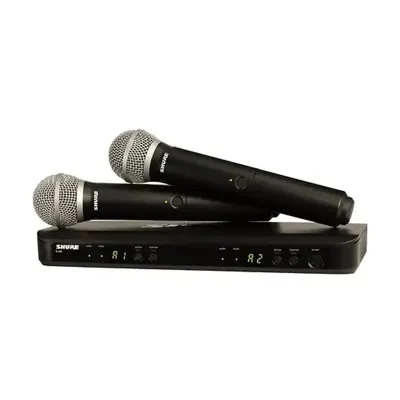
| Shure BLX288/PG58 Dual Wireless Mic System | 2 handhelds | UHF, band H10 (542-572 MHz) | Up to 300 ft line of sight | 2 AA per mic, up to 14 hr | PG58 |
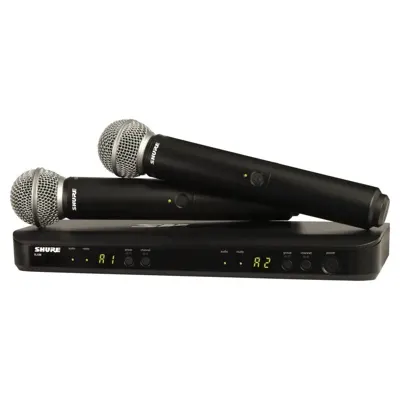
| Shure BLX288/SM58 Dual Wireless Mic System | 2 handhelds | UHF, band H10 (542-572 MHz) | Up to 300 ft | AA, up to 14 hr | SM58 |
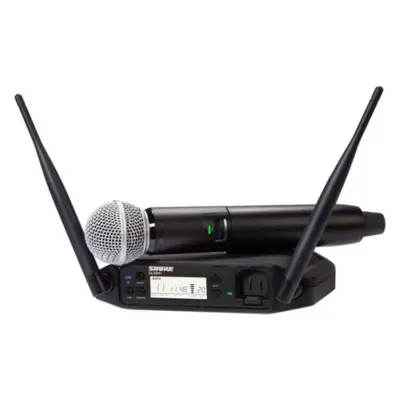
| Shure GLX-D24+/SM58 Digital Wireless System | 1 handheld | Digital, 2.4 and 5.8 GHz | Not in our listing | SB904 rechargeable Li-ion, 12-17 hr | SM58 |
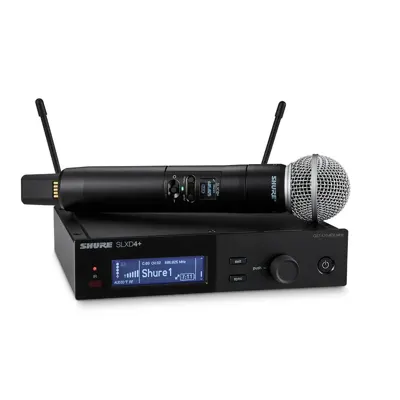
| Shure SLXD24+/SM58 Digital Wireless Mic System | 1 handheld | Digital UHF, band G57 as listed | Up to 328 ft | Not in our listing | SM58 |
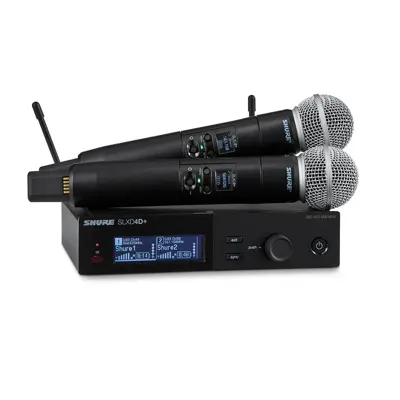
| Shure SLXD24D+/SM58 Dual Digital Wireless System | 2 handhelds | Digital UHF, band G57 as listed | Up to 328 ft | Not in our listing | SM58 |
| Shure SM58S Vocal Microphone with On/Off Switch | Wired | None (XLR cable) | Cable length | None needed | SM58 |
Band and frequency: what the listings say
The BLX24/PG58 and both BLX288 systems are listed in band H10, which covers 542 to 572 MHz. The BLX24/PG58 listing says you can run up to 12 compatible systems per band. QuickScan finds a clear frequency with one button press, which is handy when you set up in a new room.
The GLX-D24+/SM58 works in both the 2.4 GHz and 5.8 GHz bands and is sold as license-free. Its smart frequency management moves to backup frequencies on its own without audio dropouts. That makes it easy for someone who does not want to think about channels at all.
The SLX-D+ systems are digital UHF, shown in band G57 on our listings. ShowLink Ease adds automatic frequency updates and interference mitigation, and Wireless Workbench software and the WWB Mobile app let a tech watch and control the mics. If your venue has a sound person, they will like that.
Batteries: AA or rechargeable
BLX runs on two AA batteries per mic, with up to 14 hours per transmitter on the BLX288/PG58. AAs are easy to find at any store, but you have to buy them and remember to swap them. Most working DJs just put fresh ones in before every gig.
The GLX-D24+/SM58 comes with an SB904 rechargeable lithium-ion battery rated for 12 to 17 hours depending on band. The receiver has a charging bay, and a 30-minute charge gives about three hours of use. Our SLX-D+ listings do not cover battery details, so ask Joe what power options fit your setup.
Capsule and sound: PG58 or SM58
The capsule is the head of the mic, the part that turns your voice into signal. The BLX24 and BLX288/PG58 use the PG58 cardioid vocal capsule. The BLX288/SM58, the GLX-D24+, and both SLX-D+ systems use the SM58 capsule, the same voice people know from wired Shure mics.
The BLX listings show 50 Hz to 15 kHz audio response. The SLX-D+ listings show 20 Hz to 20 kHz and 118 dB of dynamic range, with 2.8 ms latency. For speeches and toasts, either one gets the job done. On a singer or a loud MC in a big room, a pro system usually gives you more headroom to work with.
Single or dual
One mic is fine if you are the only one talking. Weddings, quinceañeras and church services almost always need two: one for the DJ or MC and one for toasts, readings or a duet.
The BLX288/PG58 and BLX288/SM58 put two handhelds on one BLX88 receiver. The BLX288/PG58 listing calls out XLR and 1/4-inch outputs from a compact tabletop receiver. The SLXD24D+/SM58 runs two SM58 handhelds on one SLXD4D+ receiver, with audio summing to combine both mics to one output plus included rackmount hardware and antennas. That rack kit matters if you build your gear into a case.
GLX-D+ in our lineup is the single GLX-D24+/SM58. If you need two, you would pair two systems, so plan on two receivers and two mixer inputs.
Who each one suits
First wireless mic: BLX. It is simple, scans for a channel with one button and runs on batteries you can buy anywhere. The BLX24/PG58 is a good start, and the BLX288 is the move if you already know you will need two mics.
Weekend DJ or MC who hates buying AAs: GLX-D+. The rechargeable battery and charging bay mean you charge it on the way to the gig and smart frequency management handles the channels for you.
Churches, venues and working DJs out every weekend: SLX-D+. You get the longest listed range here, encryption, rack mounting on the dual and software monitoring for whoever runs sound.
A wired SM58S as backup, and what else you need
Whatever wireless you pick, keep a wired Shure SM58S and an XLR cable in the bag. It is the classic SM58 with an on/off switch, so a speaker can mute it without touching the mixer. If a battery dies mid-toast or a room is full of radio noise, you plug it in and keep going.
You also need a free mic input on your mixer or powered speaker. Bring a photo of the back of your gear and Joe will tell you what plugs where. All of these are buy and pick up at the shop at 8696 Atlantic Ave in South Gate, and you can ask about our Payment Plan.
Stock moves, so call (323) 944-7844 or text (213) 674-9042 to confirm the system you want is on the floor before you drive over.
In the shop
Gear from this post
Buy Now, Pay Later
 Buy Now, Pay Later
 Buy Now, Pay Later
 Buy Now, Pay Later
 Buy Now, Pay Later
 Buy Now, Pay Later

DJ and pro audio
Featured DJ Pro gear
Pioneer DJ, AlphaTheta, QSC, JBL, Electro-Voice, Shure and more, most with prices. Hold it for pickup in South Gate.
Fastest way to a price
Text us what you drive or what you are building
Car audio: send the year, make, and model, and Tony gets back to you with what fits and a price. DJ gear: tell Joe the room or the party, like "backyard party, 150 people" or "starter DJ setup," and he will put a setup together.
More from the blog
Wireless Microphone Buying Guide: How Many Mics and Which Ones
Start with two questions: how many people need to talk at the same time, and do they need their hands free? Most parties and quinceañeras are covered by a dual handheld system plus a wired mic as a backup. Below is how we match the mic to the event and to the speaker you already own.
Read itPA Speaker Buying Guide for Parties and Quinceañeras
Pick your PA by the event you play most, not by the biggest number on the box. A backyard party, a salon, a quinceañera with speeches and a church service each call for a different setup, and below we show what we would pull off the floor for each one and why.
Read itWired Vocal Mics Compared: Shure SM58, Beta 58A, SM7B and More, Electro-Voice ND76, ND86 and ND96
Pick the Shure SM58 for a dependable live vocal mic, the SM58S if the person talking needs an on/off switch, or the PGA58 for speeches and karaoke on a first PA. Pick the Shure Beta 58A or an Electro-Voice ND86 or ND96 for louder rooms where feedback is a fight, a condenser like the Shure SM86 or Beta 87A for more detail if your mixer has phantom power, and the Shure SM7B, SM7dB or MV7+ for podcasts, streaming and DJ voiceovers.
Read itQuestions on Shure BLX vs GLX-D+ vs SLX-D+: Which Wireless Mic Fits You
Which Shure wireless mic should I buy first?
For most people starting out, BLX. The BLX24/PG58 is one mic and one receiver, QuickScan picks a clear channel for you, and it runs on AA batteries.
Does the GLX-D+ use AA batteries?
No. The GLX-D24+/SM58 comes with an SB904 rechargeable lithium-ion battery, and the receiver has a built-in charging bay. A 30-minute charge gives about three hours of use.
What range do these systems have?
Our listings show up to 300 ft line of sight for BLX and up to 328 ft for SLX-D+. The GLX-D+ listing does not give a range, so ask us. Walls and crowds will shorten any of them.
Do I still need a wired mic if I buy wireless?
We recommend it. A wired SM58S and an XLR cable cost you nothing in setup time and save the night if a battery runs out or the room has heavy interference.
Can I try them at the shop?
Yes, come by the DJ floor in South Gate. Call or text first to make sure the system you want is in stock, and Joe can help you hook it up to your mixer or speaker.