
 Buy Now, Pay Later
Sealed vs Ported vs Loaded Enclosures: Picking a Sub Box and Size
The box matters as much as the sub. The same woofer can sound tight and punchy in one enclosure and loud and boomy in another. Here is what each type does, and how we help people pick a size.
Sealed boxes: tight and accurate
A sealed box is airtight. The air inside acts like a spring that controls the cone. That gives you fast, tight bass that follows kick drums and bass lines accurately.
Sealed boxes are also smaller for the same sub. The tradeoff is efficiency. A sealed sub needs more amp power to get as loud as the same sub in a ported box. If you listen to rock, country, or anything with fast double-kick, sealed is a safe pick.
Ported boxes: louder low end
A ported box has a vent tuned to a certain frequency. Around that tuning point, the port adds output, so you get more volume per watt. That is why most hip-hop, cumbia and banda rides use ported boxes.
Ported boxes are bigger and need to be built to the sub's specs. Below the tuning frequency, the cone is less controlled, so you do not want to feed it huge power at very low notes. A good ported box is tuned for the music you play.
Loaded enclosures: the simple route
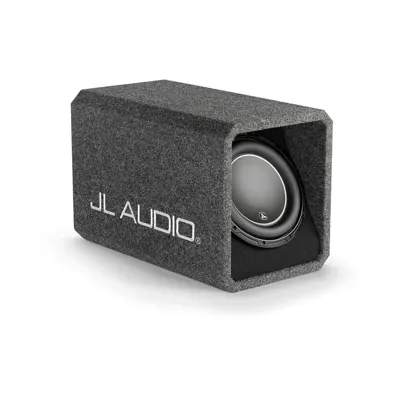
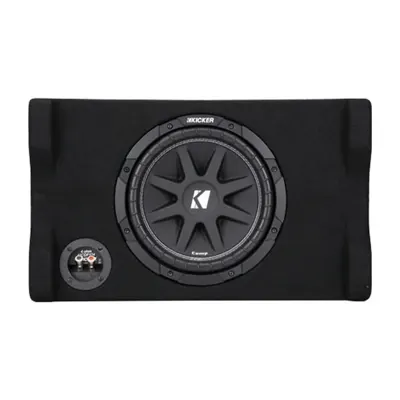
A loaded enclosure comes with the sub already mounted in a box designed for it. You skip the guesswork. The JL Audio HO110-W6v3 pairs a 10W6v3 with a slot-ported wedge box built for that driver. The Kicker 48CDF104 is a down-firing 10 that leaves the top of the box flat, so you can still stack groceries on it.
For most daily drivers, a loaded box gets you 90 percent of the way there. Custom boxes make sense when space is odd, like behind a truck seat, or when you want to squeeze out every bit of output.
10, 12 or 15 inch?
Bigger is not always louder in the real world. A 10 moves less air, but it is quick, fits in small trunks and under seats, and is easy to power. A 12 is the all-around pick. It fits most trunks and gives deeper, fuller bass without needing a monster amp. A 15 needs a big box and real power, and it shines on the lowest notes.
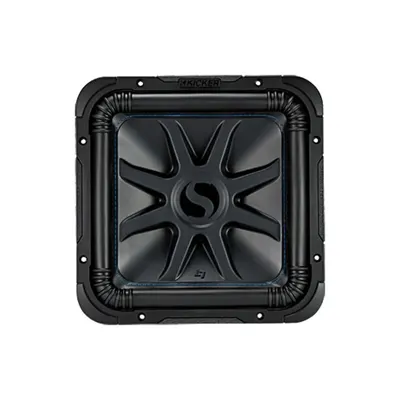
Think about space first, then power, then taste. A good 12 like the JL Audio 12W1v3 or the Kicker L7S 12 in the right box will outperform a cheap 15 in the wrong one. Match the sub's impedance to your amp too. Dual voice coil subs can be wired different ways to hit the load your amp likes.
Tell us about your car and your music
Trunk space in a sedan is not the same as a crew cab. Tell us the year, make and model and what you listen to, and we will show you options in the shop. We install in our own bay.
In the shop
Gear from this post
Buy Now, Pay Later
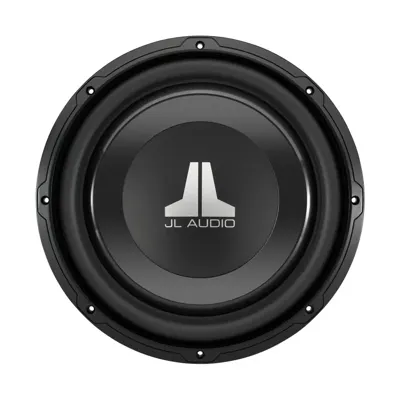
JL Audio 12W1v3-2 12-inch Subwoofer
- 300 W RMS
- Single 2 ohm
- 1.10 cu ft sealed
Holiday special, ends Dec 28
$279.99$229.99$279.99
 Buy Now, Pay Later
Shop by vehicle
Find parts that fit your car
Pick your year, make and model to see the stereos, speakers and boxes that fit it, with prices. Pickup and install in South Gate.
Fastest way to a price
Text us what you drive or what you are building
Car audio: send the year, make, and model, and Tony gets back to you with what fits and a price. DJ gear: tell Joe the speakers, mixer, controller or lighting you want, and he will tell you what is on the floor.
More from the blog
Car Subwoofer Buying Guide: Sub, Box, Amp and Wiring for Your Ride
The right sub setup depends on three things: how much space you can give up, how hard you want it to hit, and what radio you are keeping. Small space and a factory radio usually means a powered sub. A trunk or truck cab you can give up means a loaded box and a mono amp. Here is how we point people at the counter, with the parts that come along for the ride.
Read it: Car Subwoofer Buying Guide: Sub, Box, Amp and Wiring for Your Ride10-Inch Car Subwoofers Compared: JL Audio, Kicker, Alpine and Focal
A 10 fits smaller boxes than a 12. For a first sub on a modest amp, look at the Alpine W10S4, Kicker 50CWCD104 or 52CVR104, or JL Audio 10W0v3 and 10W1v3. For a truck cab or under a seat, pick a shallow 10: the JL Audio 10TW3-D4 and Alpine RS-W10D4 mount 3.25 inches deep, and the Kicker 48CWRT104 and 46L7T104 need 3-7/16 and 3-3/4 inches. For more output, step up to the Kicker 50CVX104 or 44L7S104, the Alpine S2-W10D4 or R2-W10D4, or the JL Audio 10W3v3 and 10W6v3. At the top are the JL Audio 10W7AE, the Alpine HDZ-W10 and the Kicker L7X.
Read it: 10-Inch Car Subwoofers Compared: JL Audio, Kicker, Alpine and Focal8-Inch Car Subwoofers Compared: JL Audio, Kicker and Alpine
An 8 fits where a 10 or 12 will not. For a modest amp, look at the Kicker CompC 50CWCS84 or 50CWCD84 (100 to 200 W RMS) or the JL Audio 8W1v3 (150 W RMS) and 8W3v3 (250 W RMS, in a 0.3 cu ft sealed box). For the thinnest installs, the Kicker 48CWRT8 mounts 2-11/16 inches deep and the 46L7T8 square sub 2-3/4 inches. For more output, step up to the Alpine R2-W8, the Kicker 44L7S8 square sub (450 W RMS) or the JL Audio 8W7AE-3 (500 W RMS).
Read it: 8-Inch Car Subwoofers Compared: JL Audio, Kicker and AlpineQuestions on Sealed vs Ported vs Loaded Enclosures: Picking a Sub Box and Size
Is ported always louder than sealed?
Near the port's tuning frequency, yes. Across the whole range it depends on the box design. Sealed is usually tighter and needs more power for the same volume.
Can I put a sub in a truck?
Usually, yes. Many trucks use shallow or down-firing boxes behind or under the rear seat. Tell us the year, make and model and cab style and we will look at what fits.
Should I buy a loaded box or build custom?
For most people a loaded enclosure is the smart buy. It is matched to the sub already. Custom makes sense for odd spaces or serious output goals.